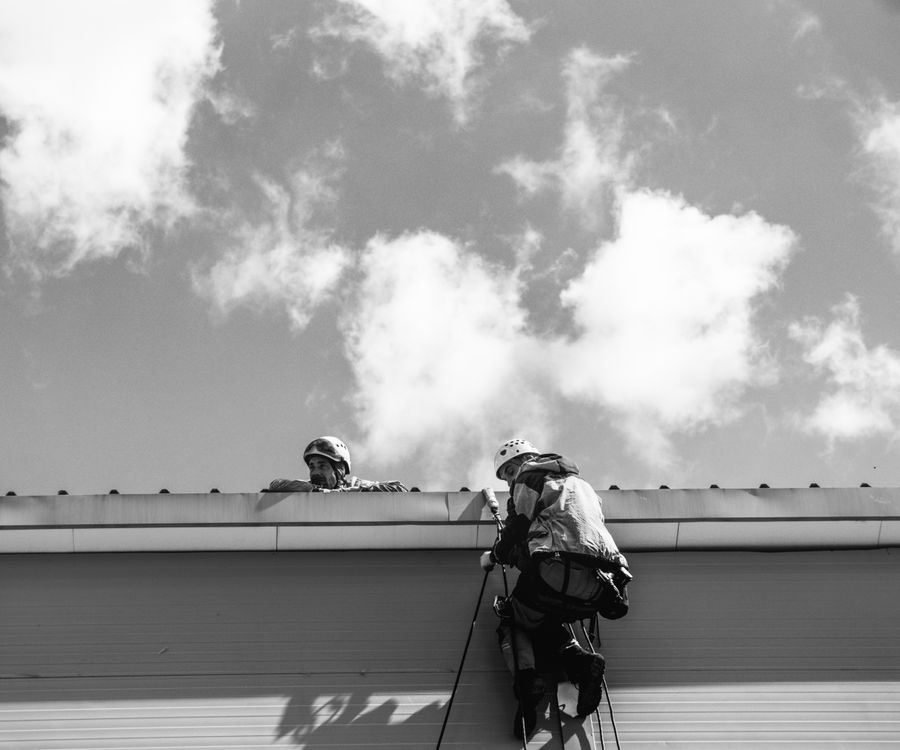

Photo by Chris Shafer via Pexels
In short: TPO, EPDM, and modified bitumen are all hail-resistant when healthy — but each fails differently. TPO can crack its top ply while looking fine from a distance. EPDM flexes well but its seams and penetrations take the hit. Modified bitumen bruises visibly and loses granules. After any hailstorm, the question isn't whether the roof "looks okay" from the ladder — it's whether someone with membrane experience got up close.
Do flat roofs even get hail damage?
It's one of the most common misconceptions in commercial property management: that hail is a shingle problem and flat roofs are immune. Flat membranes are tougher than shingles against a single stone, that's true — but they aren't immune, and the damage they take is harder to see. A shingle splits and announces itself. A membrane bruise whispers.
The three membranes that cover the vast majority of commercial flat roofs in the U.S. — TPO (thermoplastic polyolefin), EPDM (ethylene propylene diene monomer, i.e., synthetic rubber), and modified bitumen — are all single-family names hiding real physical differences. When hail arrives, those differences decide what breaks, what it looks like, and whether your adjuster will recognize it as storm damage. If you manage a building with a hail damage-exposed flat roof, knowing which membrane you're walking on changes the entire inspection.
How does hail damage TPO roofing?
TPO is the most common new commercial membrane, and it's a strong hail performer — its heat-welded seams are famously tough, and the thermoplastic surface is hard enough to bounce off moderate hail. But TPO has a specific vulnerability that surprises property managers: it can fracture without tearing.
Here's what happens. As TPO ages — especially in hot climates with heavy UV exposure — the plasticizers that keep the surface flexible migrate out. The membrane becomes more brittle. A hailstone that would have bounced off a five-year-old TPO roof can create a hairline crack in the top ply of a fifteen-year-old one. These cracks can be nearly invisible from standing height and only show up on close inspection, often as a fine spider-web pattern around the impact point.
Thickness matters a great deal with TPO. Commercial TPO typically comes in 45, 60, and 80 mils, and thicker membranes absorb impact energy meaningfully better. If your building has 45-mil TPO in a hail-prone region, that's worth knowing — and worth mentioning to your inspector after a storm.
The TPO inspection pattern after hail looks like this:
- Impact craters with fractured tops — the membrane surface shows star-shaped or spider-web micro-cracking where stones hit, sometimes with the reinforcing scrim visible.
- Seam-adjacent hits — heat-welded seams rarely split, but membrane immediately adjacent to welds can flex-crack where stiffness changes.
- Penetration flashings — the pre-formed boots and corner flashings around pipes and curbs are the thin spots; they're often where hail damage first appears.
One honest caveat: TPO's hail damage is the easiest of the three to underestimate, because the membrane often looks intact. If your roof is past its halfway mark and a hailstorm rolled through, don't accept a ground-level "looks fine."
How does hail damage EPDM roofing?
EPDM — the black rubber membrane you'll find on countless older and newer flat roofs — is arguably the most hail-tolerant of the three. It's flexible across an enormous temperature range, it doesn't embrittle the way TPO can, and hailstones that would crack a brittle surface often just bounce off rubber. If hail damage were a ranking, EPDM would usually take the fewest hits.
But "fewest hits" isn't "no hits." EPDM's weak points are where it joins things:
- Seams — older EPDM systems use adhesive-bonded seams, which are the first place hail-driven movement can cause problems. Newer tape-bonded seams are stronger, but any seam that was already aging can lift or fishmouth after a hail event.
- Penetrations — pipe boots, curb flashings, and any spot where the membrane is clamped or cut is stiffer and thinner than the field. Hail damage here often shows as tears or cuts around the fitting.
- Ballasted systems — on roofs where river rock or pavers hold the membrane down, hail can dislodge ballast and expose bare membrane, which then takes direct hits it wasn't meant to take.
Because EPDM itself is so resilient, adjusters sometimes dismiss hail claims on EPDM roofs entirely. That's where documentation of the system matters — photos of damaged seams, displaced ballast, and torn flashings make the case that the storm did real work even if the black field membrane looks fine.
How does hail damage modified bitumen?
Modified bitumen — the torch-down or cold-applied asphalt-based membrane, often with a granular surface — is the most visibly honest of the three. When hail hits it, it shows. For insurance purposes, that visibility is a feature, not a bug.
Fresh hail impacts on modified bitumen look like bruises: circular spots where granules were crushed or knocked away, leaving darker, exposed asphalt underneath. These bruises often appear in a random, scattered pattern across the field of the roof — which is exactly the pattern that distinguishes hail from wear and tear. Wear follows traffic paths, drainage patterns, and seams. Hail falls wherever it falls.
What makes modified bitumen tricky is that bruises aren't punctures. A hail bruise that doesn't break through the membrane can still be real damage: the crushed spot is thinner, the granule loss exposes asphalt to accelerated UV aging, and over months the bruised area can become a leak path. This is the damage that gets missed when an inspection concludes "no punctures, no problem." No punctures today — but the roof's service life just got measurably shorter.
Age amplifies everything on modified bitumen. A fresh, flexible membrane absorbs a lot. A fifteen-year-old membrane with a dry, brittle surface can crack under impacts that would merely dent a younger one. If your building has an older modified bitumen roof in a hail-prone area, storm documentation is especially important — because the adjuster's first instinct will be to call it age.
How do you tell hail damage from wear on any membrane?
This is the question that decides claims, so it's worth getting precise. On any of the three membranes, these patterns point to hail rather than age:
- Random distribution — hail damage scatters across the open field of the roof. Wear concentrates at seams, edges, penetrations, drains, and ponding areas.
- Soft-metal corroboration — dents in exhaust vents, HVAC housings, gutters, and flashing are hail's signature witnesses. Wear doesn't dent metal. When the membrane marks line up with dented metal in the same area, the hail story is strong.
- Fresh appearance — fresh hail bruises are darker and sharper-edged than weathered wear. Over weeks and months the contrast fades, which is why inspecting soon after the storm matters.
- Storm-date alignment — local storm reports showing hail at your address on a specific date are third-party evidence no adjuster can wave away. Note the date now, even if you can't inspect immediately.
If you've already read our guide on how big hail needs to be to damage a commercial roof, you know that repeated small-hail events add up — the same logic applies per membrane. An older modified bitumen roof that has weathered a decade of sub-severe hail is more vulnerable than its age suggests.
What should you do after hail hits your flat roof?
The playbook is short and time-sensitive:
- Record the storm date. Check local storm reports for hail at your address and save them. This is your claim's anchor.
- Photograph from a safe vantage. Capture the roof generally plus any visible marks — even phone photos from a window or parapet help establish the timeline.
- Call for a professional inspection within days. Fresh marks are easiest to distinguish from wear, and most policies expect prompt action. Ask specifically that the inspector documents membrane type, thickness (if measurable), and impact patterns — not just "roof condition."
- Don't accept a drive-by. For TPO and modified bitumen especially, real inspection means hands and knees, close-up photos, and attention to the field of the roof, not just the edges.
- Document everything in writing. A dated inspection report with photos is what turns "possible storm damage" into a claim an adjuster can work with.
If the inspection finds damage, our guide to how commercial roof insurance claims work walks through what happens next. And if you're managing multiple properties, getting ahead of the next storm with a pre-season plan is worth more than any single claim — see our services for how a proper inspection program works.
The bottom line: hail treats each membrane differently, but it never treats any of them kindly. Know which roof you're standing on, look closely, and document fast.
Photo: Professional roof inspection by Chris Shafer via Pexels.
Frequently asked questions
Is TPO or EPDM better at resisting hail damage?
Both perform well, but differently. TPO's heat-welded seams stay strong, and its thicker mil options (60 or 80) resist puncture. EPDM is highly flexible and rarely punctures from hail, but ballasted or glued seams and penetrations are its weak points. The deciding factor is usually thickness and condition, not brand.
How do you tell hail damage from normal wear on modified bitumen?
Fresh hail bruises show as dark, crushed spots where granules were knocked away, often in a random pattern across the field of the roof. Normal wear shows up gradually at seams, edges, and ponding areas. If the pattern doesn't follow traffic or drainage paths, hail is the likely cause.
Can hail damage a flat roof without puncturing it?
Yes — and this is the most commonly missed damage. On modified bitumen, hail can bruise the membrane and strip protective granules without breaking through, which shortens the roof's life. On TPO, small fractures in the top ply can hide under an intact-looking surface. A close inspection, not a drive-by, is what finds this.
Will my insurance cover hail damage on a commercial flat roof?
Standard commercial property policies typically cover hail as a named peril, but the adjuster has to agree the damage is from hail rather than age or maintenance neglect. Documentation is everything: storm dates, dated photos, and a professional inspection report give your claim its foundation.
Think your building took a hit?
Get a fast, no-obligation inspection from a local pro.